Industry 4.0 Edge
Connecting industrial assets to decisions without moving the production process into the cloud.
Industry 4.0 becomes practical when connected assets produce contextual, actionable information at the point where operations occur. Edge computing provides the local layer that connects equipment, retains high-value raw data, runs time-sensitive processing, and publishes structured outcomes to the systems that need them.
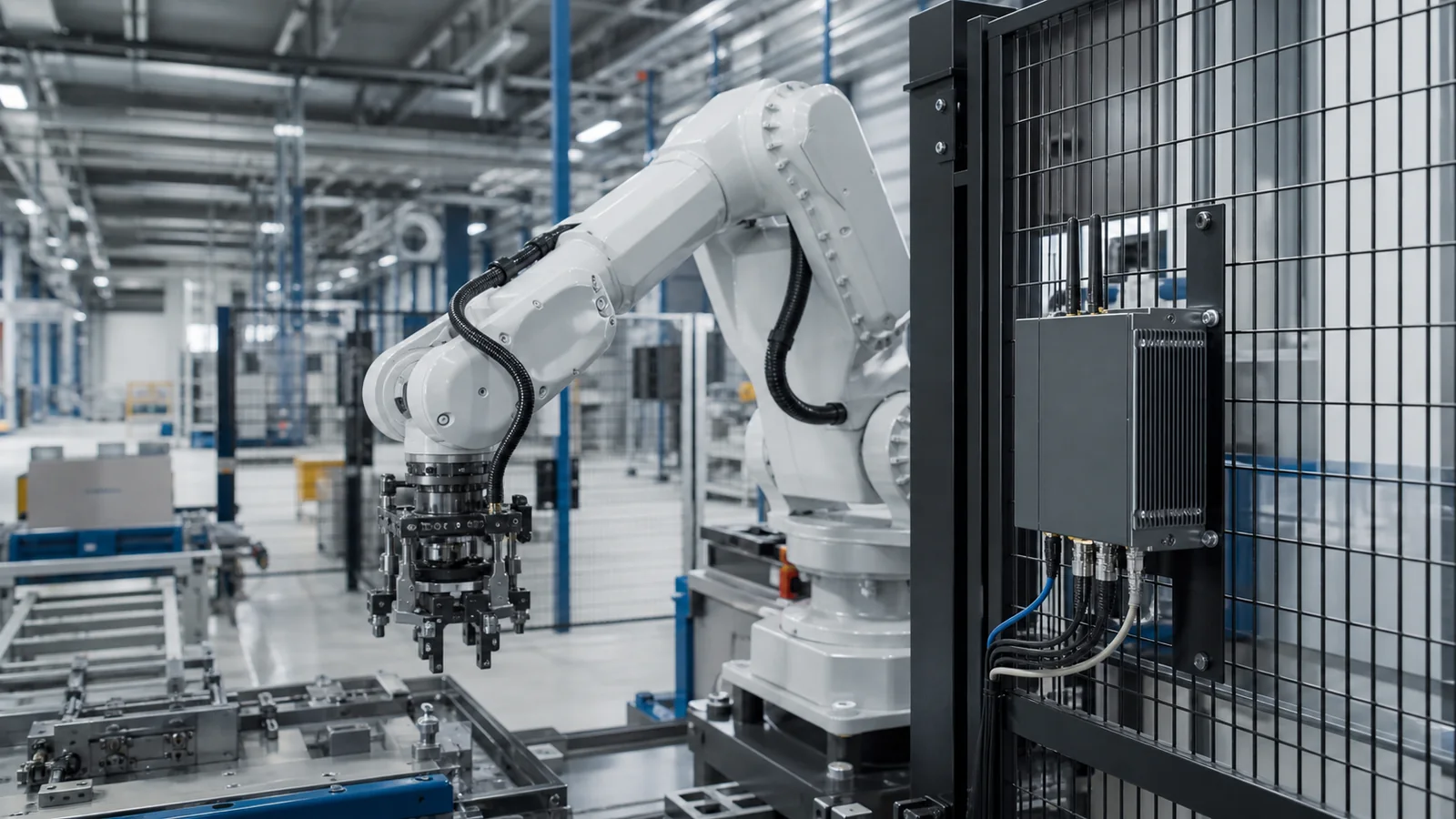
Connected equipment is only the starting point
Industry 4.0 is often described through connected machines, digital twins, AI, and data platforms. Those concepts are useful, but a production team needs a more concrete outcome: the right people and systems must receive a trustworthy representation of what is happening on the line, with enough context to act.
That outcome does not come from collecting every possible tag in a central repository. It comes from a controlled local system that understands devices, preserves signal timing, evaluates meaningful conditions, and publishes a stable operational result. The edge is where that local system runs-close enough to machines, cameras, sensors, and operators to remain effective when a WAN link is slow, unavailable, or unsuitable for raw data.
Banalytics provides the edge orchestration and monitoring layer for cameras, sensors, and industrial devices. It connects local sources, runs tasks and event rules, records data on operator-owned hardware, and makes structured outputs available to dashboards, MQTT consumers, APIs, and external systems. The foundational product model is described in What is Banalytics?.
Organise the connected production cell around data responsibility
A scalable Industry 4.0 design separates field acquisition from domain intelligence and operating workflows. That separation is what lets teams connect existing equipment without making every process change a complete software rebuild.

| Layer | Industry 4.0 role | Examples |
|---|---|---|
| Physical assets | Produce process state, condition signals, visual context, and machine telemetry. | PLCs, meters, cameras, DAQ hardware, acoustic and vibration sensors, relays, process instruments. |
| Edge connectivity | Reach mixed equipment through local industrial and IoT interfaces. | Modbus lines, MQTT devices, ONVIF/RTSP cameras, USB devices, local gateways, custom adapters. |
| Edge processing | Apply fast or data-intensive logic near the source. | Signal analysis, computer vision, feature extraction, thresholding, fusion, custom ML or vendor SDK services. |
| Operational orchestration | Turn result state into retained evidence, notification, action, and human visibility. | Banalytics events, rules, dashboards, history, local storage, MQTT publications, operator workflows. |
| Enterprise and cloud systems | Aggregate, plan, learn, and coordinate beyond one production cell. | SCADA, MES, historian, CMMS, AI training infrastructure, reporting, data lake. |
Use protocols as contracts, not as isolated integrations
Industry 4.0 estates are heterogeneous. The edge node has to communicate with older equipment and newer services without forcing a single vendor stack onto the entire line. Banalytics supports direct local connectivity for Modbus, MQTT, cameras, and ZeroMQ-based services, then makes that data available to rules and downstream consumers in a consistent event model.
For Modbus equipment, the Modbus Line manages one or many devices over serial, TCP, UDP, or RTU-over-TCP. It provides state tracking and polling events rather than leaving a register map as an opaque integration detail. For IoT messaging, the MQTT Server can run on the edge node itself, with TLS, password or mutual-TLS authentication, persistence, WebSocket access, and runtime statistics.
Where an installation depends on a specialist protocol, vendor SDK, or existing analytical service, the integration should stay explicit. A sidecar or custom module can communicate through ZeroMQ, MQTT, HTTP, files, or another defined contract; Banalytics then owns its lifecycle, operational state, and result routing. This boundary is more maintainable than treating a proprietary bridge as an undocumented exception.
Publish decisions with their operating context
A raw register value or a model score rarely explains enough on its own. To be useful for an operator, historian, maintenance system, or future analysis, an industrial event should carry its source, timestamp, location or asset identity, state transition, confidence where appropriate, and the health of the path that produced it.
For example, an acoustic monitoring module may identify an anomaly candidate. The Banalytics edge node can attach the event to the acquisition source, record the event time and confidence, retain or reference the local waveform, update the dashboard, publish an MQTT message, and notify a maintenance workflow. Downstream systems receive an actionable event rather than a continuous high-rate stream they were never designed to store or interpret.
The Event Manager is the local coordination point for this pattern. It evaluates events against rules and can trigger a controlled response-such as an MQTT publish, alert, task lifecycle action, recording step, or approved custom command. The event contract is the durable integration surface; it should be designed before the pilot, not inferred after it.
Keep the production data path independent of remote availability
Remote dashboards and enterprise systems add value, but they should not be the only place where a production cell can interpret a condition. The Banalytics Agent runs local acquisition, processing tasks, recording, storage, and event logic on the site host. Each node therefore remains responsible for the equipment it serves while authorised users obtain remote visibility through the browser console.
Local autonomy is especially important for high-volume video, waveforms, and multimodal data. Raw material can remain on local disk or attached storage; structured outputs travel upstream through the selected integration path. The same design also reduces the blast radius of a network interruption: a remote reporting delay should not automatically become a blind spot at the production cell.
Autonomy does not remove the need for operations. Use System Monitor to observe CPU, memory, disk, threads, streams, and WebRTC buffers; use retained event history and clear escalation rules to detect a degraded node before it compromises collection or response.
Do not confuse edge automation with functional safety
Industry 4.0 projects often combine monitoring, recommendation, and limited operational automation. Those are valid edge use cases. They do not transfer authority away from systems designed for functional safety. Safety interlocks, emergency stops, and deterministic process protection belong to the PLC, safety relay, DCS, or SIS that has been engineered and approved for that role.
Banalytics can monitor state, coordinate a controlled workflow around an event, and send commands through configured interfaces. Every action that can affect equipment should therefore be treated as an engineering decision: confirm the writable address or target, enforce least-privilege access, keep the triggering rule narrow, test in a safe environment, and preserve a clear audit trail.
Start with one cell and scale a proven operating pattern
- Choose a bounded use case. Select one machine, line, or condition where the signal, response, and business value are understood.
- Map the data path. Define devices, protocols, ownership, timing, local retention, event schema, and every downstream consumer.
- Prove the full workflow. Validate connection recovery, throughput, storage, event quality, and operator response using actual production-style conditions.
- Harden the node. Establish monitoring thresholds, restart behaviour, update/rollback procedures, access boundaries, and handover documentation.
- Replicate the pattern. Reuse the validated contract for further machines or sites, changing only the equipment-specific parameters and domain logic.
The Industrial Sensing guide provides the corresponding engineering model from interface definition through funded pilot and hardened deployment: How Banalytics Works for Industrial Sensing.
An Industry 4.0 edge layer for physical-system operations
Banalytics is suited to Industry 4.0 projects that need an operating layer around mixed physical devices: local data acquisition, modular runtime capabilities, events and actions, edge storage, remote visibility, and a stable handoff to external systems. It is particularly useful when an organisation already has domain algorithms or plant systems and needs to make their deployment observable and repeatable.
It is not a claim that every industrial protocol or vertical platform feature is natively available. Where a deployment needs an unsupported gateway, specialized model, or proprietary service, that element should be implemented as a clear integration boundary. This keeps the production architecture honest and gives the operator a system that can evolve with equipment rather than being constrained by it.