Industrial Edge Computing
How to place computation where industrial data can be acted on reliably.
Industrial edge computing puts acquisition, processing, and operational response near the equipment that produces the data. The goal is not to eliminate cloud services; it is to ensure that high-volume, time-sensitive, or site-sensitive work remains dependable when the network is imperfect and the physical process continues.
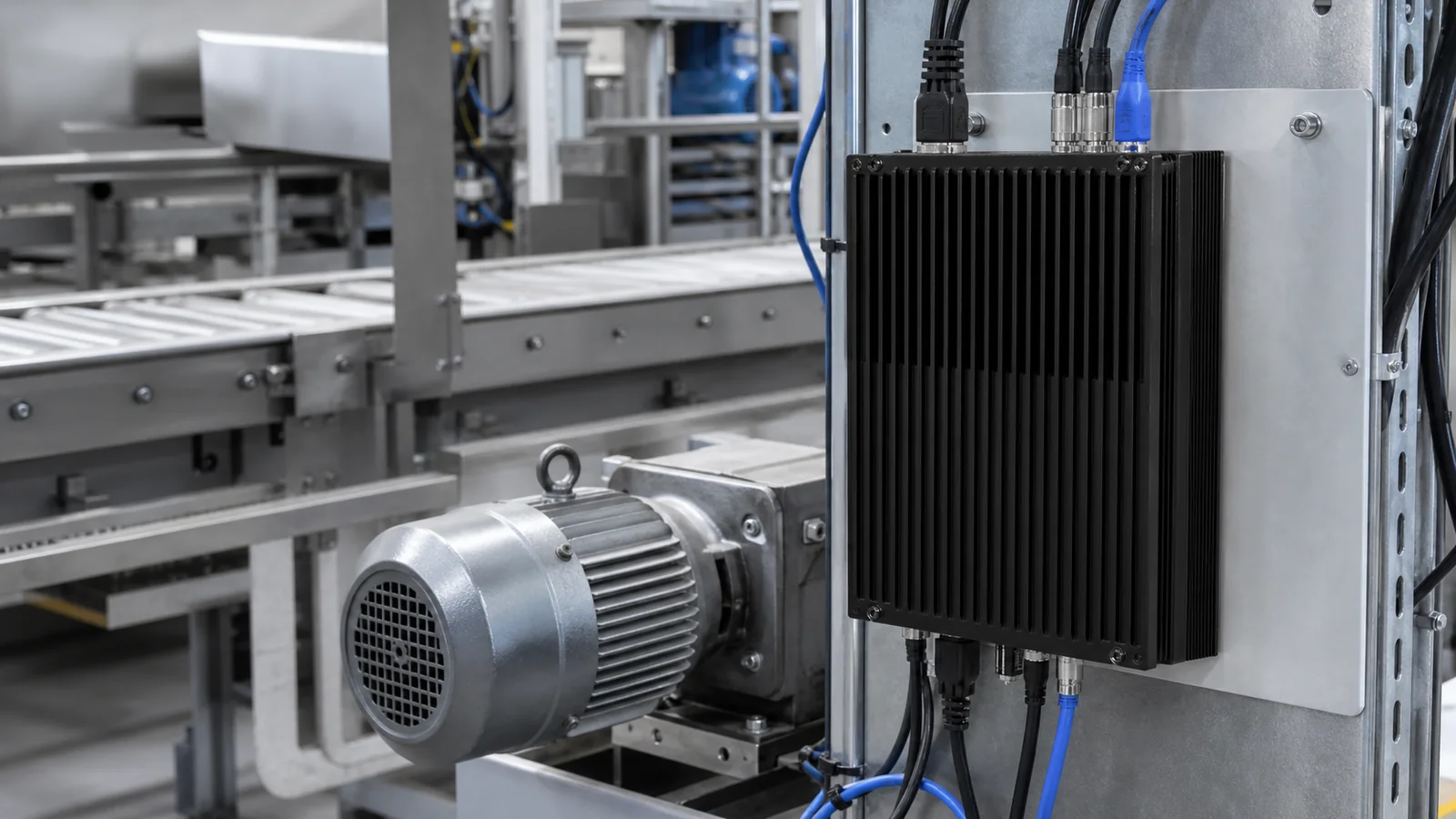
Industrial edge computing is a placement decision
Industrial systems generate information where work happens: on a production line, in a substation, at a loading bay, beside a test rig, or inside a remote facility. The useful question is not whether a workload is “cloud” or “edge” in the abstract. It is where each part of the workload should execute so that latency, resilience, data ownership, cost, and operational responsibility are appropriate for the process.
At the edge, a local computer connects to field devices, acquires raw streams, executes selected processing, retains the material that must remain on site, and produces structured operational outputs. Cloud or central systems can then aggregate, train models, retain enterprise history, or coordinate business workflows without being placed in the critical path for every frame, measurement, or control-adjacent event.
Banalytics provides the local operating layer for this pattern: it connects physical sources, manages local tasks and storage, evaluates events, and gives operators remote visibility. It does not replace a safety controller, a PLC, or a domain algorithm; it makes the system around them operational. See What is Banalytics? for the platform scope.
Four conditions make local execution the rational choice
| Condition | What fails in a remote-only design | Edge computing response |
|---|---|---|
| High-volume raw data | Continuous transfer of video, images, or waveforms consumes bandwidth and creates an unnecessary central storage burden. | Capture and retain raw data locally; export events, metadata, selected clips, or curated datasets. |
| Time-sensitive decisions | Variable WAN latency and remote queueing make response time difficult to predict. | Evaluate local conditions and trigger local or plant-network workflows before publishing the result upstream. |
| Intermittent connectivity | An upstream outage turns into a data loss or a blind operational period. | Continue acquisition, buffering, recording, and local rules independently; reconcile or publish when the connection is available. |
| Data governance | Raw material leaves the controlled site even when downstream users only need a decision or summary. | Preserve the raw archive at the edge and expose a defined, minimal output contract. |
These conditions often coexist. A machine-vision node may need both deterministic local response and a locally retained image sequence for later investigation. An acoustic-monitoring system may need to process a high-rate waveform locally while forwarding only anomaly candidates, confidence scores, and health tags to a maintenance system.
Place each workload at the layer that can own its consequences
| Function | Preferred location | Rationale |
|---|---|---|
| Functional safety and hard interlocks | PLC, safety relay, DCS, or SIS | These controls retain the authority and certification intended for the process. An edge platform should not be presented as their replacement. |
| Device acquisition and protocol handling | Edge node | Devices are local; protocol latency, network segmentation, and driver ownership are managed close to the asset. |
| Real-time signal or image processing | Edge node or local processing service | Large payloads and short response requirements favour local execution. A dedicated module can use the hardware and libraries it needs. |
| Event routing and operator workflow | Edge node, with controlled upstream publication | The local system can alarm, record, and preserve context even if a remote service is unavailable. |
| Enterprise history, model training, cross-site analytics | Central data platform or cloud | These workloads benefit from aggregation and elastic compute once latency and raw-data locality are no longer critical. |
This division produces a hybrid architecture, not an isolated island. Banalytics can publish structured events and selected outputs to MQTT, APIs, files, databases, or other consumers while keeping the raw acquisition path near the equipment. The Industrial Sensing reference architecture explains this acquisition-to-processing-to-orchestration pattern in detail: How Banalytics Works for Industrial Sensing. The deployment view in Industrial IoT Edge Platform shows how a real-time measurement node, independent analysis, and an orchestration node can be separated without placing raw high-volume data on the remote management path.
Separate the operating layer from domain intelligence
Industrial edge computing does not require every algorithm to be reimplemented in one platform. In a well-structured deployment, Banalytics owns connectivity, buffering, local storage, task lifecycle, events, dashboards, and publication. The team’s specialist module owns the analysis: image classification, waveform processing, feature extraction, fusion, or confidence scoring.
The interface between them should be explicit. Define input and result payloads, timestamp rules, health tags, expected throughput, restart behaviour, and the response to back-pressure. This is what allows the local system to be tested as a system rather than as a set of individually successful software demonstrations.
For compact telemetry and event streams, MQTT is often a suitable local bus; Banalytics can host an embedded broker or connect to an existing broker. For direct industrial device state, the Modbus Line supports multi-device serial and network topologies. For custom services or higher-rate local messaging, use ZeroMQ Socket or a managed Process sidecar.
Edge computing must be engineered for recovery, not only throughput
A system that performs well in a clean lab can still fail in production when a camera reboots, storage fills, a packet stream pauses, or a model update changes resource use. Industrial edge nodes need a recovery model that acts at the smallest safe scope: restart a task before a component; restart a component before the Agent; use a host-level supervisor for the rare case where the complete Agent process must return.
Resource visibility is part of the design. The System Monitor publishes CPU, memory, disk, thread, stream, and WebRTC metrics as events that can be displayed, retained, or used in rules. For media and AI workloads, memory must be considered as both Java heap and native memory; the relevant limits and tuning considerations are documented in JVM Settings.
The resulting operational loop is continuous: acquire, process, observe, recover, retain, and report. Treating these as separate products usually creates gaps precisely when a plant team needs evidence of what happened.
Validate the edge contract before scaling the hardware
Industrial edge projects should begin with a representative path, not the widest possible rollout. The first node is the place to confirm that the device interface, transport, storage rate, processing behaviour, event quality, and operator workflow all work together under conditions that resemble production.

- Define the contract. Agree on data sources, timing, result schemas, error states, ownership boundaries, and what remains local.
- Run a real-device pilot. Measure data rates, end-to-end response time, buffer behaviour, storage retention, failure recovery, and the usefulness of the operator view.
- Harden and replicate. Tune lifecycle policies, permissions, update and rollback procedures, monitoring thresholds, and handover documentation before extending to another line or site.
Questions to answer before committing to an industrial edge design
- Which raw inputs must remain on site, and which outputs are sufficient for external consumers?
- What is the maximum tolerated delay from a condition to an operator notification or downstream message?
- What happens during a WAN outage, a local storage warning, a disconnected device, or a stalled processing module?
- Which system owns safety authority, and which actions are merely operational automation?
- How will the team observe resource pressure, version changes, and the health of every local node?
- What interface lets a specialist model or vendor service evolve without breaking the surrounding operating workflow?
Industrial edge computing is valuable when the answers lead to a system that is faster to act, more resilient to network conditions, and easier to operate. Banalytics supplies the local orchestration and monitoring layer that makes that design repeatable across cameras, sensors, industrial devices, and custom processing modules.