Edge Solution for Small Cities
Practical local monitoring for small municipalities, towns, and settlements with limited budgets and technical capacity.
Small communities face many of the same operational risks as large cities, but rarely have the budget, staff, or network infrastructure for a centralised control room. An edge approach gives each priority location a modest, supportable local monitoring boundary and lets the municipality share only the evidence and status needed with the people and organisations able to respond.
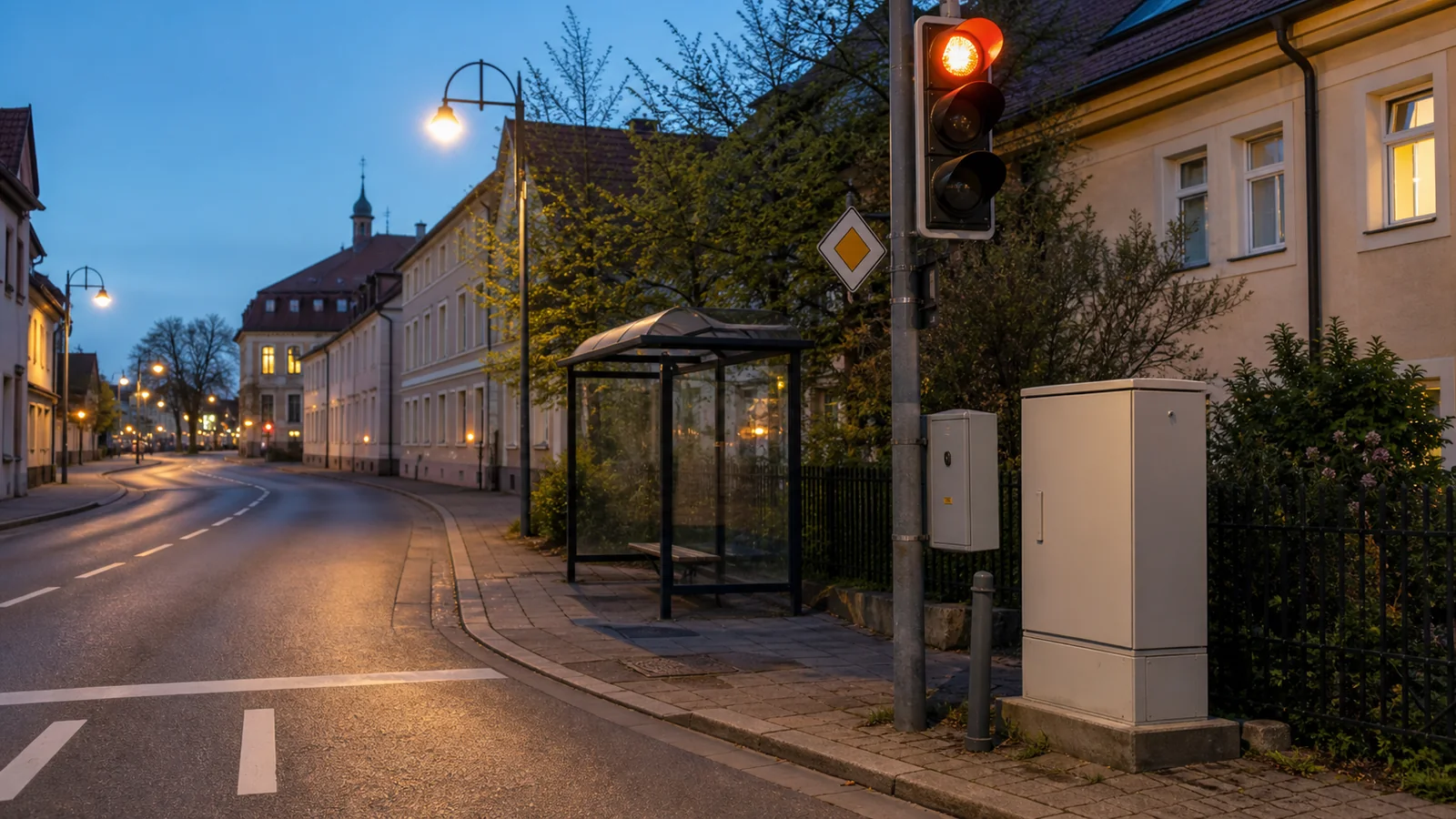
Infrastructure needs do not shrink with the population
A small town may manage a water intake, pumping equipment, public buildings, roads, waste sites, parks, bus stops, schools, a riverbank, and dispersed rural infrastructure with only a handful of technical staff. A failure can be just as disruptive as it is in a large city, but there may be no 24/7 operations centre, no resident integration team, and no budget for a proprietary platform that assumes permanent high-bandwidth connectivity.
The result is often a patchwork: a stand-alone camera at one location, an alarm panel at another, a spreadsheet for maintenance, and individual residents reporting problems by telephone or social media. The issue is not a lack of data. It is the absence of a repeatable path from observation to credible, time-stamped context, responsible review, and a proportionate response.
Energy assets are often the most practical starting point: a municipal building, pump station, lighting cabinet, or remote facility already has a clear service owner and a measurable cost or availability consequence. Energy Edge Computing shows how a small municipality can create local evidence and maintenance context around those assets without building a central control room first.
An edge solution starts with one question: what decision must this community make earlier or with better evidence? That may be identifying a failed pump before a service interruption, confirming that waste collection has become a safety issue, watching a flood-prone culvert, observing a recurring wildlife crossing, or giving a maintenance contractor reliable site context. The technology should be selected around that outcome, not around an ambition to digitise everything.
Give each priority site a small, autonomous operating boundary
| Element | Purpose in a small municipality | Design principle |
|---|---|---|
| Local edge node | Connect devices, retain selected data and evidence, evaluate approved rules, and keep functioning through a poor uplink. | Use an appropriately sized Windows, Linux x86_64, or Linux ARM64 host close to the site, rather than relying on a permanent connection to a remote data centre. |
| Focused device set | Capture the few signals that directly support an accountable service outcome. | Begin with existing cameras, meters, controllers, sensors, or a field gateway; avoid a broad sensor rollout before ownership and response are clear. |
| Local event logic | Turn a condition into an understandable, time-stamped operational event. | Specify source, freshness, threshold or rule, severity, evidence, recipient, and the expected human response. |
| Shared access | Allow a small internal team, contractor, or authorised agency to review selected operational context. | Share the minimum necessary information with role-based access and a written purpose, rather than opening every live device to every party. |
Banalytics runs the local integration and orchestration layer through an Agent. It can connect to cameras, Modbus equipment, MQTT devices, files, and custom processes; component outputs can be used in dashboards, event history, rules, and external integrations. The platform overview explains the Agent model, and How Banalytics Works for Industrial Sensing shows the acquisition-to-orchestration pattern in more detail.
Reduce operating complexity before adding coverage
For a small municipality, the long-term cost of a system is usually more important than the purchase price of a sensor. The team must be able to understand the alerts, find the site, maintain the local host, rotate credentials, keep enough storage, and know who to call when a component stops reporting. A design that requires a specialist to interpret every anomaly will not remain useful after the initial project ends.
- Use a phased site pattern. Prove one high-value site, document its device and response contract, then replicate it where the operating conditions are comparable.
- Reuse existing interfaces. Connect to established Modbus, MQTT, camera, or gateway interfaces when they meet the need; reserve custom integration work for a defined gap.
- Make alerts specific. Notify people about an actionable condition with a location and timestamp, not every raw value or transient network reconnection.
- Make remote support purposeful. Give authorised staff or contractors controlled browser access to the sites they support instead of maintaining an always-open administrative path.
- Measure maintenance effort. Track storage, device freshness, host health, and recurring fault types so the next investment solves a demonstrated operational problem.
Banalytics System Monitor exposes CPU, memory, disk, thread, media, WebRTC, and user-activity state as events. This helps a small team distinguish a full local disk, a stale field device, and an unavailable remote viewer-conditions that need different actions. For remote access, Portal Integration uses signalling to establish an authorised browser-to-Agent WebRTC connection without placing the portal in the local acquisition path.
Let residents contribute evidence without turning them into a control room
Residents often see a local problem first. A recurring wildlife crossing, illegal dumping, a damaged fence, smoke near a protected area, an overflowing stream, or unsafe activity at a public site may be visible long before it reaches an official workflow. Community-run observation points can strengthen situational awareness when they are designed as a governed evidence channel rather than an informal surveillance network.
| Community use case | Appropriate edge pattern | Responsible data sharing |
|---|---|---|
| Wildlife and environmental observation | A camera or sensor at a permitted location records locally and creates selected observations or time-bounded evidence. | Share approved observations with environmental organisations, land managers, or conservation authorities under an agreed purpose, access scope, and retention policy. |
| Local safety concern | A resident, local group, or site owner contributes an authorised monitoring point that produces a clear event with source and time context. | Route urgent situations through the designated emergency or public-safety channel; use the monitoring system as supporting evidence, not as a substitute for emergency response. |
| Flood, weather, or asset condition | A local node collects measurements or visual context close to the location and flags defined threshold or freshness conditions. | Provide selected status to municipal maintenance, water management, civil-protection, or ecological bodies that are authorised to assess and act. |
| Volunteer-maintained sensor network | Each contribution has a documented location, owner, calibration or maintenance responsibility, and communication state. | Label data quality and freshness explicitly; do not present unverified volunteer telemetry as an official measurement or dispatch instruction. |
This model needs clear safeguards. Obtain the required permissions for a location and any camera; define a legitimate purpose; avoid collecting more personal data than the outcome requires; state who can view a live feed or retained evidence; and provide a route to remove or disable a contribution. Environmental observation should focus on the area or species of concern, not on creating a broad record of people’s movements.
Share the right view with the right organisation
Different stakeholders need different information. A municipal technician may need a current device state and maintenance history. An environmental organisation may need a time-stamped wildlife observation with location and confidence. A public-safety organisation may need a concise incident reference and the authorised evidence path. Giving every party the same dashboard or raw feed increases both cost and risk.
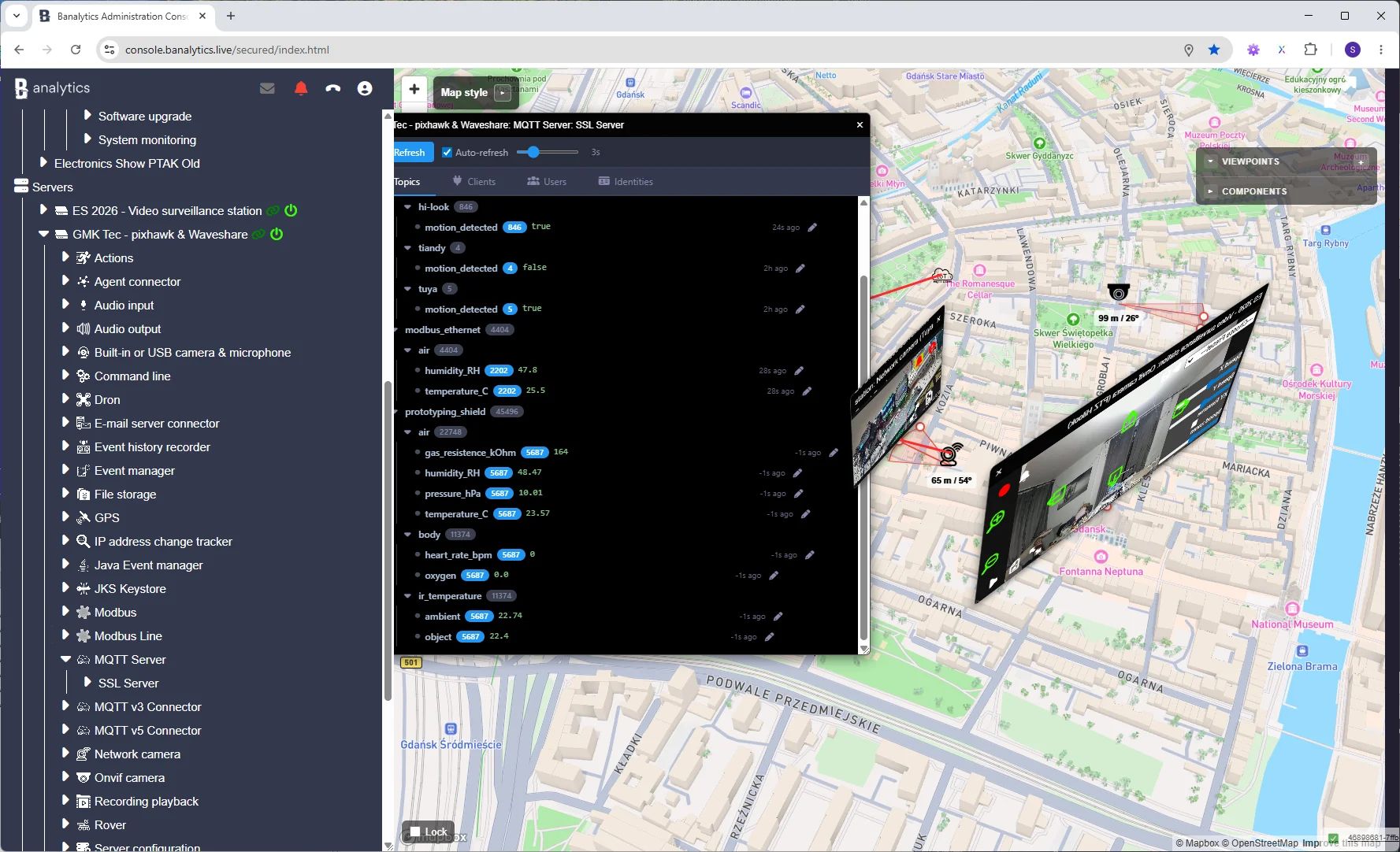
Dashboard providers can add geographic context for approved assets, observations, and site status. A Mapbox, Cesium, or OpenStreetMap dashboard can be configured according to the required map view, while the analytical components retain their own data-source and access rules. The screenshot below illustrates how map context, device markers, and selected event data can be brought together for an authorised operator.
For the broader architecture of autonomous local nodes, data minimisation, multi-site operations, and public-infrastructure governance, see the companion white paper Smart City Edge. It addresses the same local-first foundation at the scale of a wider municipal estate.
Keep control of data with the organisation that owns the deployment
A local-first architecture is useful for privacy because it allows the owner of the physical equipment to decide what is collected, retained, displayed, and shared. A Banalytics Agent runs on infrastructure selected and administered by that owner. The owner configures device connections, retention, user access, dashboards, event rules, and external integrations. Banalytics does not autonomously choose the purpose of monitoring, the recipients of data, or the conditions under which a resident’s observation is disclosed.
This is a technical and operating-model boundary, not a substitute for legal analysis. The organisation responsible for the deployment must determine its role under applicable law, the lawful basis for each processing purpose, the required notices, and the contractual responsibilities of any provider or partner that processes personal data. Where Portal Integration is used, Banalytics infrastructure retains only the connection data needed to link an authorised user with the physical equipment. After signalling, the user’s browser and the Agent communicate through an isolated peer-to-peer WebRTC channel; the application traffic does not pass through Banalytics infrastructure. Local acquisition, processing, and storage remain at the deployment boundary. See Portal Integration for the technical model.
On-premise delivery for municipal and community sovereignty
For small cities and settlements, an on-premise deployment is the recommended operating model when the municipality and its authorised community operators need complete, non-shared control of their infrastructure. The city controls the physical hosts, identities, data stores, network boundaries, retention, and access rules; no third party gains access merely because Banalytics software is deployed. Any support or external integration access must be explicitly granted, scoped, and revocable by the deployment owner.
On-premise control does not mean isolation from useful cooperation. A municipality can integrate a defined part of its infrastructure with another city, environmental organisation, emergency service, or contractor through a deliberate MQTT, API, file, or dashboard boundary. Each connection should state the permitted data package, recipient, purpose, rate, security controls, retention, and revocation procedure. This makes inter-municipal sharing a governed owner decision rather than an unavoidable consequence of using a shared platform.
| GDPR consideration | What the municipality or site owner should define | How a local edge boundary helps |
|---|---|---|
| Purpose limitation and data minimisation Articles 5 and 25 | Name the operational purpose, sources, data fields, retention period, and the smallest useful audience before enabling a monitoring point. | Raw camera and sensor inputs can remain at the local site while a configured rule publishes only a selected event, aggregate, or evidence reference. |
| Lawful basis and transparency Articles 6, 13, and 14 | Establish the applicable lawful basis, provide required information to affected people, and distinguish civic reporting from an official authority workflow. | Each source and dashboard can be configured for a defined purpose and access scope instead of being exposed through one unrestricted shared feed. |
| Controller, processor, and sharing roles Article 28 where applicable | Record who decides the purpose and means, which parties process data on instruction, which organisations receive it, and the contract or other legal mechanism governing each handoff. | MQTT, APIs, files, and dashboards are explicit integration boundaries; each can be limited to the data package and recipient approved by the owner. |
| Security of processing Article 32 | Set access roles, credentials, authentication, transport protection, device-maintenance procedures, incident response, and review of external accounts. | Keeping acquisition near the site reduces unnecessary exposure of continuous raw data and lets the deployment apply controls at each local boundary. |
| High-risk monitoring and DPIA Article 35 | Assess whether a planned activity is likely to create a high risk to people’s rights and freedoms; consult the DPO, legal adviser, and relevant national supervisory-authority guidance before deployment where required. | Purpose-specific data flows, retention controls, and evidence of who accessed what make the assessment and any mitigations easier to implement and review. |
Systematic monitoring of publicly accessible areas, particularly at scale, can require a Data Protection Impact Assessment (DPIA). The European Data Protection Board explains that controllers must carry out a DPIA before processing likely to result in high risk to individuals’ rights and freedoms. Review the EDPB’s DPIA guidance and the GDPR text together with the guidance of the competent national authority.
For community-supported observation, the practical rule is simple: do not ask residents to operate an informal surveillance network. Give every contribution a stated purpose, permitted location, owner, access policy, data-quality label, review route, and removal process. Urgent public-safety concerns must still go through the designated emergency channel. This paper is an architectural guide, not legal advice; the deployment owner should obtain advice from its data-protection officer or qualified counsel before processing personal data.
Keep the handoff to authorities and contractors explicit
Integration should produce a small, useful package: event type, source, location where relevant, time, data-quality or confidence indicator, severity, evidence reference, and a link to the responsible workflow. Banalytics Event Manager can evaluate configured conditions and invoke preconfigured actions such as a notification or MQTT publication; see Event Manager. The action is not the governance model: every recipient must know whether it is being informed, asked to investigate, or authorised to act.
Do not automate high-consequence physical actions from a community observation point or an unverified external signal. The domain system that owns water control, public safety, traffic, or environmental intervention must retain its independent authority, safe-state design, and human operating procedure. Edge monitoring can shorten the path to good evidence; it should not blur responsibility.
Start with a problem the community can actually sustain
- Name one outcome and owner. Choose a bounded concern with a municipal, site, or partner organisation responsible for review and response.
- Map the evidence path. Define source, location, local retention, event rule, users, external recipients, and what happens if the network is unavailable.
- Prove the local path. Test device collection, source freshness, storage, event creation, and local recovery at the actual site.
- Prove the response path. Run a real review exercise with the municipal team, contractor, environmental body, or public-safety organisation that will receive the information.
- Publish governance rules before inviting contributions. Set permissions, privacy controls, maintenance ownership, quality labels, access revocation, and incident-escalation procedures.
- Replicate only what is supportable. Expand to the next location when the first site has a stable owner, useful evidence, and a maintained response process.
The right edge solution for a small city is not a miniature version of a metropolitan control room. It is a network of modest, accountable local systems that help scarce staff and trusted partners see a problem earlier, understand it in context, and respond with the right authority.