Logistics Edge Computing
Local operational intelligence for warehouses, yards, cold chains, loading docks, and mobile logistics equipment.
Logistics operations happen where goods, equipment, and people meet-not where the central application is hosted. Edge computing keeps time-sensitive acquisition, validation, and operational context close to that physical flow, while sharing selected outcomes with WMS, TMS, maintenance, and customer-facing systems.
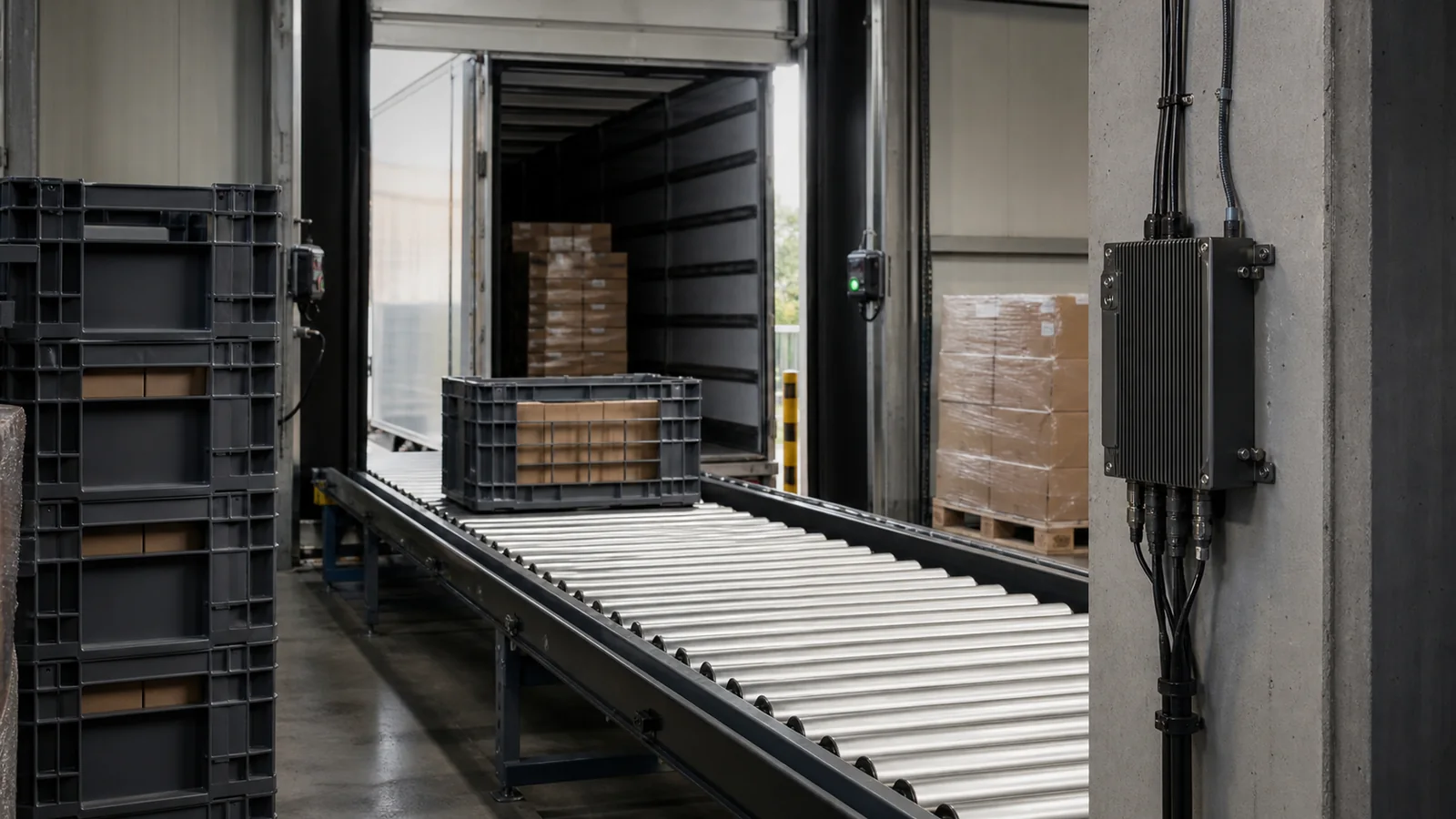
Every movement needs a trustworthy local context
A warehouse or logistics site combines many fast, independent processes: receiving, staging, scanning, storage, picking, packing, loading, dispatch, material handling, and temperature-controlled storage. Their data may originate in scanners, scales, cameras, PLCs, conveyors, doors, environmental sensors, mobile equipment, and external applications. A central WMS or TMS is essential for planning and records, but it is rarely the right place to be the first endpoint for every raw signal or time-sensitive observation.
The operational question is usually local: is a dock ready, has a pallet reached a zone, is a cold-store condition current, did a conveyor stop, is a camera observation relevant, or is a mobile asset still reporting? The edge node can connect inputs, validate their freshness, retain configured evidence, produce a structured event, and keep its defined local workflow active when the upstream link is degraded.
Banalytics provides this local orchestration and observability boundary through an Agent running on a Windows, Linux x86_64, or Linux ARM64 host at the site. Components connect resources; tasks execute local work; events and rules create controlled responses; dashboards and integrations expose the selected result. See What is Banalytics? for the platform overview.
Keep the local physical flow independent from the shared data flow
| Layer | Responsibility | Examples |
|---|---|---|
| Physical assets | Generate state, measurements, media, identifiers, or machine signals. | Scanners, cameras, scales, conveyors, PLCs, doors, sensors, refrigeration equipment, AGVs, forklifts, and packing stations. |
| Site edge node | Acquire data, timestamp and validate it, retain configured local evidence, and create events. | Industrial PC, server, or compact ARM device near a warehouse network, dock area, sorting line, or cold room. |
| Local operating logic | Evaluate bounded conditions and provide a defined local response or integration handoff. | Stale scan source, zone exception, temperature deviation, equipment status, loading event, or camera observation. |
| Enterprise and partner systems | Use approved structured outputs for planning, records, maintenance, customer communication, or reporting. | WMS, TMS, ERP, CMMS, quality system, carrier integration, dashboard, MQTT consumer, API, or historian. |
| Protected machine authority | Retain the systems that command equipment and enforce safety. | PLC logic, safety controllers, machine interlocks, vehicle controls, and designated operating procedures. |
The boundary between local operations and enterprise systems is an engineering decision, not an organisational preference. A site needs a documented answer for what continues during a WMS/TMS, WAN, or cloud-service outage; how local events are retained; and which selected records must be reconciled later. The edge node should make that answer explicit rather than leaving it to each device integration.
Apply local intelligence where delay or lost context creates cost
| Logistics area | Local edge responsibility | Useful downstream outcome |
|---|---|---|
| Receiving and loading docks | Combine approved equipment state, camera or sensor context, and time-stamped local events around arrivals, departures, doors, and staging conditions. | Dock exception, equipment state, evidence reference, and an event package for dispatch or warehouse workflow. |
| Cold chain and controlled storage | Collect environmental and equipment values locally, monitor freshness, retain configured history, and flag defined excursions. | Time-stamped condition event, data-quality context, maintenance task, and approved quality or compliance handoff. |
| Sorting and conveyor operations | Observe machine and controller state, device connectivity, local process events, and associated visual context where authorised. | Line exception, equipment-health signal, structured event for WMS/maintenance, and local evidence for diagnosis. |
| Yard and mobile equipment | Receive approved telemetry or position data, track communication freshness, and expose the current operational state to authorised users. | Selected position or mission status, maintenance context, and a workflow event; vehicle safety and driving authority remain local to the machine. |
| Returns and quality inspection | Retain permitted observations and correlate them with source, time, condition, and local process state. | Inspection event, approved image or evidence reference, and a concise package for quality or returns processing. |
Use explicit interfaces between equipment and business workflows
Logistics sites tend to evolve rather than arrive as a single designed system. A new scanner gateway may publish MQTT, a conveyor controller may expose Modbus, a camera may use ONVIF or RTSP, and an enterprise service may offer a file drop or API. The edge layer should turn each of these into an owned interface with a named schema and failure behaviour.
The Modbus Line component supports serial and network variants, multi-device polling, state tracking, and event generation. The embedded MQTT Server can provide a local broker for gateways and site applications, while an MQTT Topic Listener converts a defined message into a Banalytics event. The contract must state topic or register meaning, unit or identifier format, source timestamp, expected rate, quality state, authentication, retention, and what a consumer should do when the upstream service is unavailable.
Do not treat an event as a substitute for the WMS or TMS transaction of record. The event should give the receiving system enough context to reconcile or act, while the project defines which system owns inventory, shipment, customer, and financial state. This prevents a local observation from silently becoming an ungoverned duplicate business record.
Monitor the local node as part of the logistics process
Banalytics Event Manager evaluates configured conditions and invokes preconfigured actions. A rule can notify a supervisor, retain a configured record, publish a concise MQTT message, or call an approved integration. The most useful event includes its source, location or zone, time, state, data quality, severity, evidence reference, and the person or system expected to respond. See Event Manager for the rule-and-action model.
Banalytics System Monitor reports CPU, memory, disk, thread, media, WebRTC, and user-activity state as System state events. Combine this with device-level freshness: a full local disk, disconnected scanner gateway, stale temperature sensor, failed camera stream, and blocked external consumer require different runbook steps. The point is not to restart every node; it is to diagnose the failing boundary.
For a multi-site operation, authorised browser users can reach the required Agent context through Portal Integration without making the remote portal the mandatory route for local acquisition. This supports remote diagnostics and shared visibility while the site retains its local process boundary.
Prove one local flow before connecting the entire network
- Choose one physical flow. Start with a dock, cold room, sorting cell, yard zone, or inspection station with a named operational owner and a measurable outcome.
- Document the boundary. Define devices, input semantics, retention, event schema, local response, enterprise consumers, access roles, and outage behaviour.
- Prove the local path. Test collection, freshness, local evidence, event creation, and the intended response with the upstream business system unavailable.
- Validate reconciliation. Confirm how selected local events are represented in WMS, TMS, maintenance, or quality workflows, and how duplicates and missed handoffs are handled.
- Exercise failure modes. Simulate device loss, stale data, storage pressure, an unavailable consumer, and host recovery; improve the runbook with each result.
- Replicate deliberately. Reuse the pattern where sites and flows are comparable; record variations for customer contracts, cold-chain rules, equipment, or network constraints.
Logistics edge computing is not a replacement for the systems that plan and record the supply chain. It is the local operating layer that preserves timely context around the physical flow, so those systems and the people using them receive information that is actionable, governed, and resilient.