Agriculture Edge Computing
Local intelligence for farms, greenhouses, packhouses, and mobile agricultural equipment.
Agricultural operations are physical, seasonal, and often network-constrained. Edge computing keeps acquisition, analysis, and time-bounded operational decisions close to the field process, while sharing selected information with agronomy, maintenance, logistics, and farm-management systems.
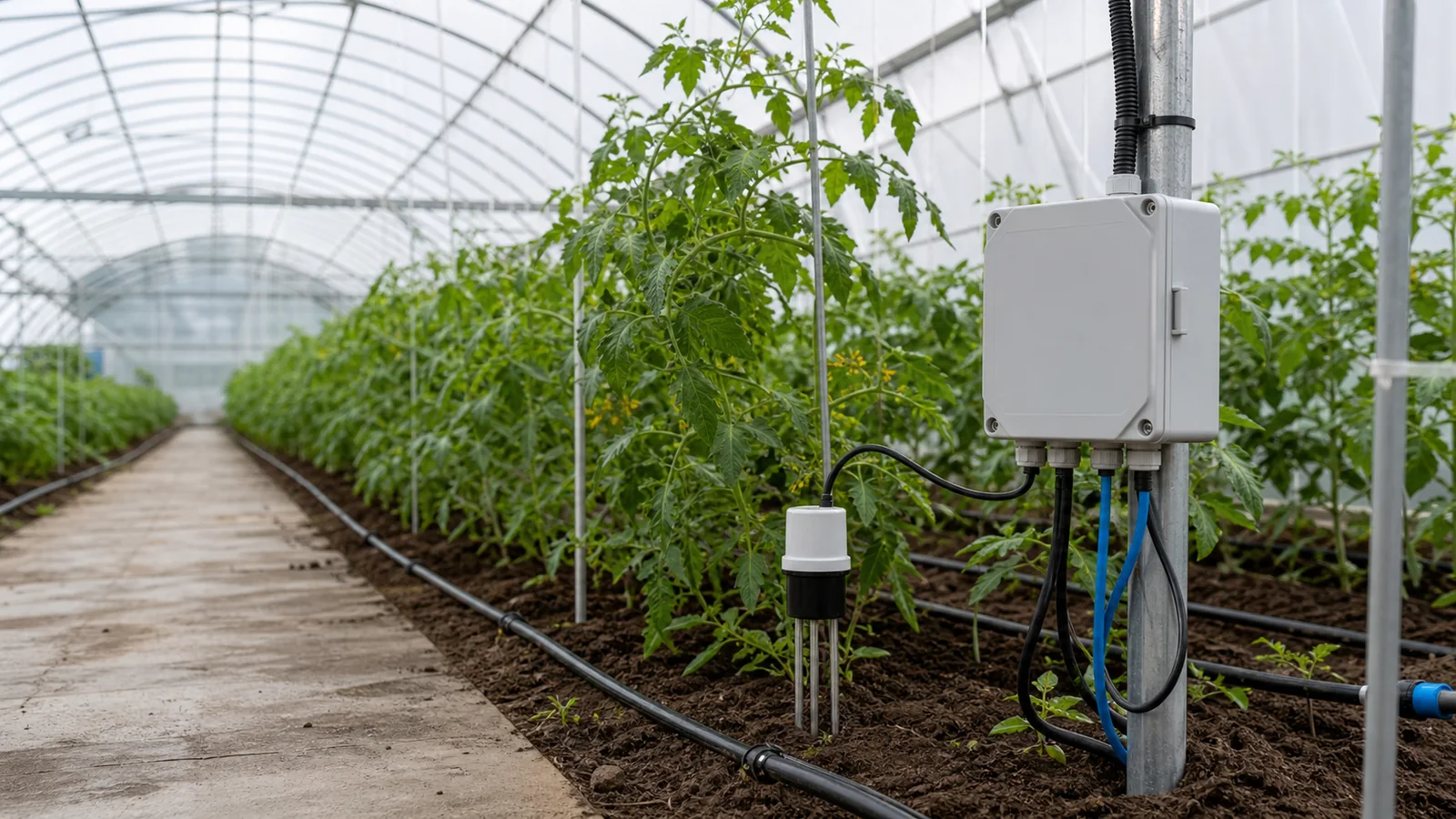
Farm data is only useful when it remains connected to the work
Agricultural data originates at widely separated locations: a greenhouse bay, irrigation cabinet, dairy unit, grain store, packing line, weather station, field gateway, or machine in motion. Connectivity may be intermittent, the window for intervention may be short, and many signals have value only when their location, crop stage, equipment state, and time of measurement are known together.
Sending every camera stream and raw sensor reading to a remote service first is rarely the most reliable operating model. A local edge node can keep devices connected, validate freshness, retain the required evidence, calculate a bounded local result, and raise a structured event even while the upstream link is unavailable. The remote layer can then receive the information needed for coordination rather than becoming a dependency for each local decision.
Banalytics provides this local execution boundary through an Agent running on a Windows, Linux x86_64, or Linux ARM64 host selected for the site. It connects to devices and integrations, manages components and tasks, and makes their outputs available to rules, dashboards, history, APIs, and authorised remote users. See What is Banalytics? for the platform overview.
Build a local system around each production boundary
| Layer | Responsibility | Typical agricultural examples |
|---|---|---|
| Field and facility assets | Generate measurements, images, machine states, or control signals. | Weather probes, soil or substrate sensors, flow meters, PLCs, cameras, scales, ventilation controllers, and equipment gateways. |
| Site edge node | Acquire locally, timestamp, check data quality, execute approved tasks, retain data, and produce events. | An industrial PC in a greenhouse, a compact server in a packhouse, or an ARM gateway near a remote pump or field network. |
| Local operational logic | Evaluate bounded conditions and hand off a defined result to an operator or domain controller. | Sensor freshness alarm, temperature excursion, blocked-flow indication, camera observation, or equipment-health warning. |
| Shared operations and integration | Expose selected status and history to authorised people and systems. | Farm-management software, agronomy reporting, maintenance workflows, dashboard views, MQTT consumers, APIs, or a specialist irrigation controller. |
The boundary should follow ownership and failure behaviour, not an arbitrary device count. A greenhouse compartment, irrigation zone, storage facility, or packing cell is a useful edge scope when it can continue its intended local operation through an upstream outage and when a responsible team can identify its devices, data contract, and response procedure.
Use edge computing for outcomes that need local context
| Operational area | Local edge responsibility | Selected outcome for other systems |
|---|---|---|
| Greenhouse and controlled environment | Read environmental and equipment signals, verify sensor freshness, retain local history, and flag deviations against the site’s approved operating envelope. | Exception events, trend summaries, equipment status, and the data needed for a grower or controller to decide the response. |
| Irrigation and water assets | Acquire meter, pressure, pump, valve, or cabinet state locally; identify communication loss or readings outside expected bounds. | Time-stamped faults, consumption summaries, and controlled integration messages to the system that owns actuation. |
| Crop and livestock observation | Collect approved camera and sensor inputs close to the location; run permitted detection or capture workflows; retain the necessary local evidence. | Structured observations, exception alerts, approved clips or image references, and device-health context. |
| Post-harvest and packhouse operations | Observe process equipment, environmental conditions, material movement, and local storage capacity near the line. | Quality or throughput exceptions, machine-state changes, traceable operational events, and maintenance signals. |
| Mobile machines and remote fields | Maintain local collection and event creation despite weak backhaul; publish positions or telemetry only when the source integration and policy permit it. | Mission status, selected telemetry, connectivity health, and synchronised records once a link is available. |
These are integration patterns, not an assertion that an edge platform should replace a certified irrigation controller, safety system, or agricultural machine control system. Where actuation is involved, the equipment owner must define interlocks, authority, manual override, safe state, and the exact command contract. Banalytics can provide observation, orchestration, and governed integration around that boundary.

Normalise the local inputs before automating a response
A farm rarely starts from a uniform technology stack. New sensors may publish MQTT while established controllers expose Modbus registers, cameras use ONVIF or RTSP, and a specialist gateway provides its own API or files. The edge layer should make those interfaces explicit and avoid hiding protocol-specific assumptions inside an operational rule.
For field and facility equipment, the Modbus Line component supports serial and network variants, multi-device polling, state tracking, and event generation. The embedded MQTT Server provides a local publish/subscribe boundary for sensors, gateways, and applications, with authentication and transport controls suited to the deployment. An MQTT Topic Listener turns an inbound topic message into a Banalytics event that can be routed through a documented rule.
Before applying a rule, define the semantic contract for each input: units, calibration ownership, expected update interval, timestamp source, acceptable range, quality flag, and what a missing value means. A temperature of 24 is not an operating fact until its unit, location, sensor health, and age are known. This discipline reduces false alerts and prevents a downstream dashboard from treating stale telemetry as current.
Make local analytics explainable and operationally bounded
Local analytics are valuable when they produce a result that an operator can understand and act on. A condition can be a calculated sensor threshold, a communication-quality change, a camera observation, or an output from a specialist agronomy model. The key is to retain the inputs, time, source, confidence or quality information, and rule that produced the result.
Banalytics Event Manager evaluates events against configured conditions and invokes preconfigured actions. This is appropriate for controlled operational flows such as notifying a responsible team, starting a recording, publishing a concise MQTT message, or handing a result to a farm-management integration. Review Event Manager for the rule-and-action model. For camera workloads, local YOLO detection can provide object-detection events; project teams remain responsible for selecting, validating, and monitoring the model for the crop, animal, or scene in question.
Do not equate detection with a final agronomic or safety decision. Use confidence thresholds, representative validation data, exception review, and a defined human escalation path. If a model’s performance changes with lighting, season, dust, crop growth stage, or camera placement, that is an operating condition to monitor rather than an edge case to ignore.
Design for an unreliable uplink without accepting an unobservable site
Rural and outdoor deployments should assume intermittent backhaul, power events, weather exposure, and limited hands-on support. The local node must therefore be able to keep its defined acquisition and processing responsibilities while the remote connection is down. When the link returns, an operator needs enough status and history to distinguish a temporary communication loss from a device, storage, or processing failure.
- Define local retention. Set the storage location, duration, cleanup behaviour, and evidence requirements for measurements, images, clips, and event history.
- Monitor freshness, not only reachability. A reachable gateway with an old probe reading is not a healthy sensor path.
- Plan power and recovery behaviour. Document startup order, network reconnection, safe restart conditions, and physical access arrangements for every remote node.
- Keep commands deliberate. Separate observation and notification from control authority; verify acknowledgement and safe-state behaviour at the system that owns actuation.
- Protect field access. Use role-scoped access, secured credentials, and authenticated interfaces before exposing a site node beyond its trusted network.
Banalytics System Monitor reports CPU, memory, disk, thread, media, WebRTC, and user-activity metrics as System state events. Use these with device-level freshness signals so a support team can distinguish a saturated host, full storage, an unavailable camera, and a disconnected sensor network rather than applying a generic restart to every alert.
Prove one farm boundary before scaling the estate
- Choose one measurable operating outcome. Start with one greenhouse zone, irrigation asset group, storage facility, or packhouse cell and name the accountable operational owner.
- Document the local data contract. List devices, units, polling or message intervals, retained data, event schema, external consumers, access roles, and outage behaviour.
- Prove the offline path. Test acquisition, local history, event creation, and the intended local response while the upstream link is unavailable.
- Validate analytics in representative conditions. Include changing light, weather, crop stage, sensor maintenance state, and the actual operating cadence of the site.
- Test the human workflow. Confirm that recipients can interpret an event, reach the site context, acknowledge responsibility, and escalate correctly.
- Replicate deliberately. Reuse a proven component and data contract where sites are comparable; record deviations for each crop, facility, machine, or regional operating condition.
Agriculture edge computing does not make a farm generic. It gives each field and facility a dependable local operating boundary, then makes the right information available to the people and systems that need to act across the wider estate.